If you've got exciting news to share, then you can trust that the official body, the Conseil Interprofessional Vins du Languedoc (CIVL), will do an amazing job broadcasting it to the world. They are on a mission to prove that the Languedoc is all about quality and modern light fresh wines with youthful appeal. They want to dispel any previous ‘cheap and cheerful’ misconceptions and demonstrate how they are producing fine wines that bear the characteristics of the hot southern France – but with a light touch and freshness.
Jean-Claude Mas of Les Domaines Paul Mas, a key figure in the Languedoc, explains how well the Languedoc is placed. “We are living a real revolution in the wine business – too much has been done simply for financial reasons. Wine should be about lifestyle, experience and enjoyment.”
“The best wine is made with passion and here in the south of France we have passionate families and companies and beautiful terroirs. Wine should be about the everyday luxury. I call it ‘luxe rural’. We are making, with a passion, excellent affordable wines for people to drink and enjoy. Most are between five and 25 euros. Wine should be made to be drunk,” he says in a rallying cry.
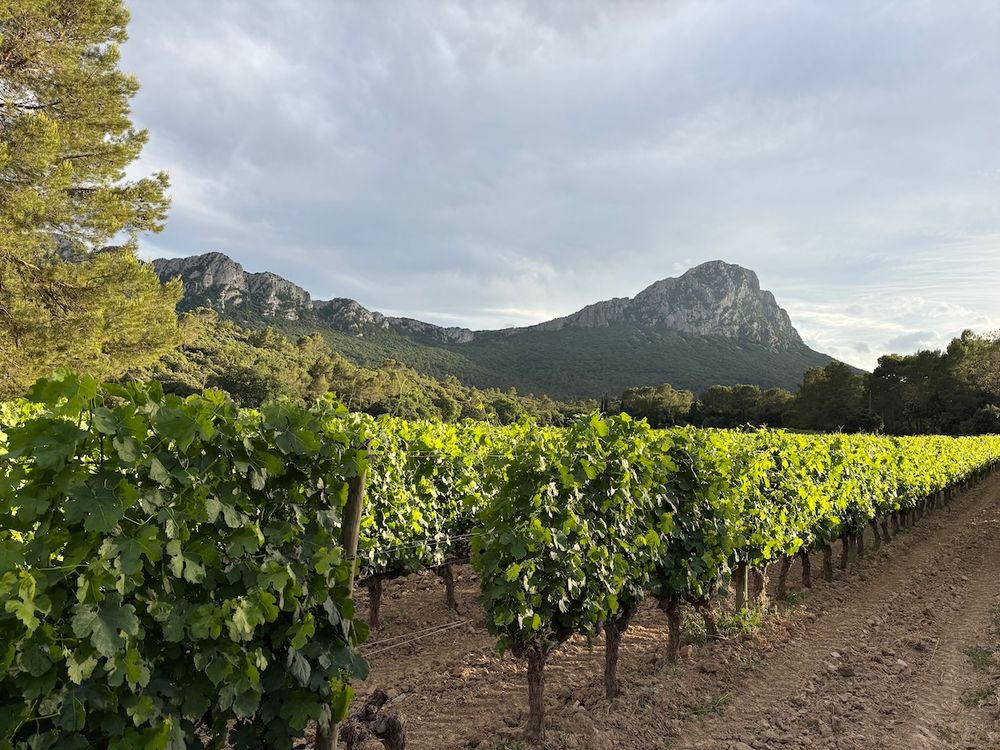
Stunning natural beauty of the Languedoc - all 200km of it
“Luxe rural”
One needs little proof that the South of France can offer ‘luxe rural’. Throughout the trip we see areas of stunning natural beauty with panoramic vistas, mountain peaks and valley plains. In the warm June sunshine, there are bright colours, captivating landscapes and a mosaic of rural countryside, passionate wineries and local farms.
The Languedoc region is France’s largest producer of wines and is vast at almost 200km in length. Every second, it is said, five bottles of Languedoc-appellation wine are sold (three in France and two overseas). 40% of wines produced are red, 50% rosé and 10% white. The wine producing area is described as a monumental amphitheatre facing the Mediterranean Sea and stretching 40km inland.
Appellations cover three types of land form, the fertile coastal plains stretching from Narbonne to Béziers and beyond Montpellier, the hills and mountains inland where vines grow up to 400m above sea level and the Atlantic corridor, and the Seuil de Naurouze, the watershed between the Atlantic and the Mediterranean.
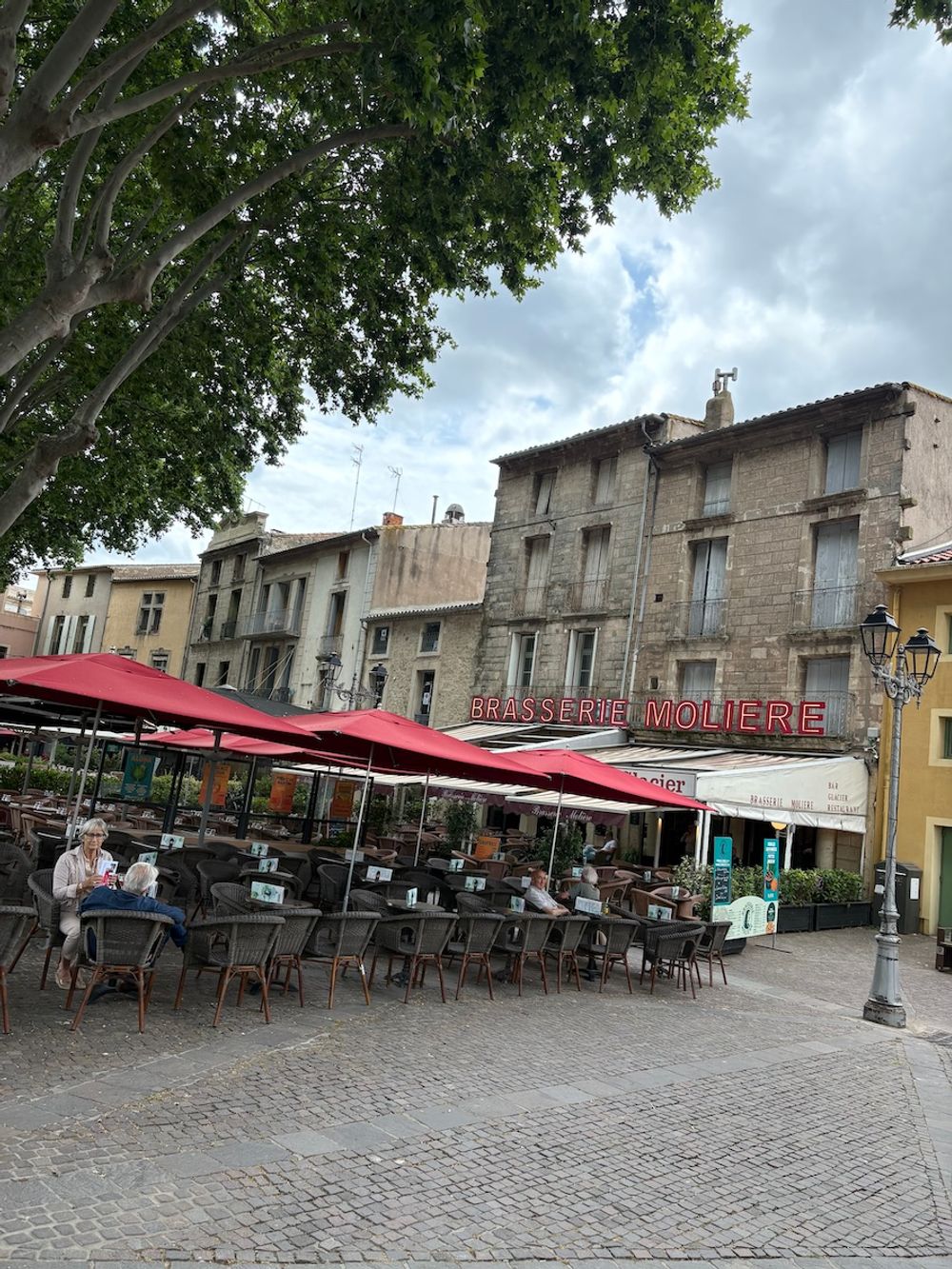
Brasserie and statue both dedicated to Molière in Pézenas
The most recent new appellations and those about to come on-stream provide a new lens through which to view the dynamism of the whole region. We are based 45 minutes south west from Montpellier in the beautiful historic town of Pézenas, claimed to be the birthplace of the career of French playwright, actor and poet Molière. A statue and many bar names pay homage to the great literary French figure. But we travel widely to meet with winemakers, assess the wine and witness first-hand the new dynamism of the region.
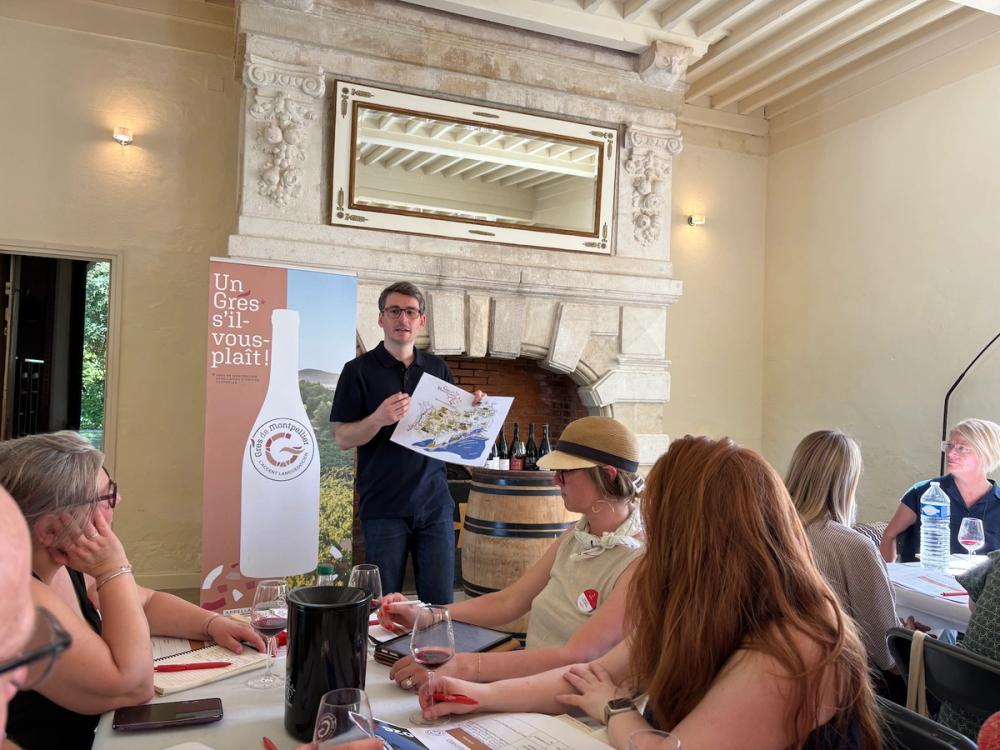
Grès de Montpellier masterclass with Mathieu Chastaing at Château Saint Martin de la Garrigue
Grès de Montpellier
The newest appellation is Grès de Montpellier which gained AOP status in 2024. It is an expansive array of vineyards dotted around an area that rings the city of Montpellier and is named after grès, meaning poor stony soils. Vines are scattered amongst garrigue, woodland and moorland. The 1950s marked the start of the area’s drive to improve quality and it brings together some of the oldest estates and newer wine growers with an iconic bottle engraved with the appellation’s signature image.
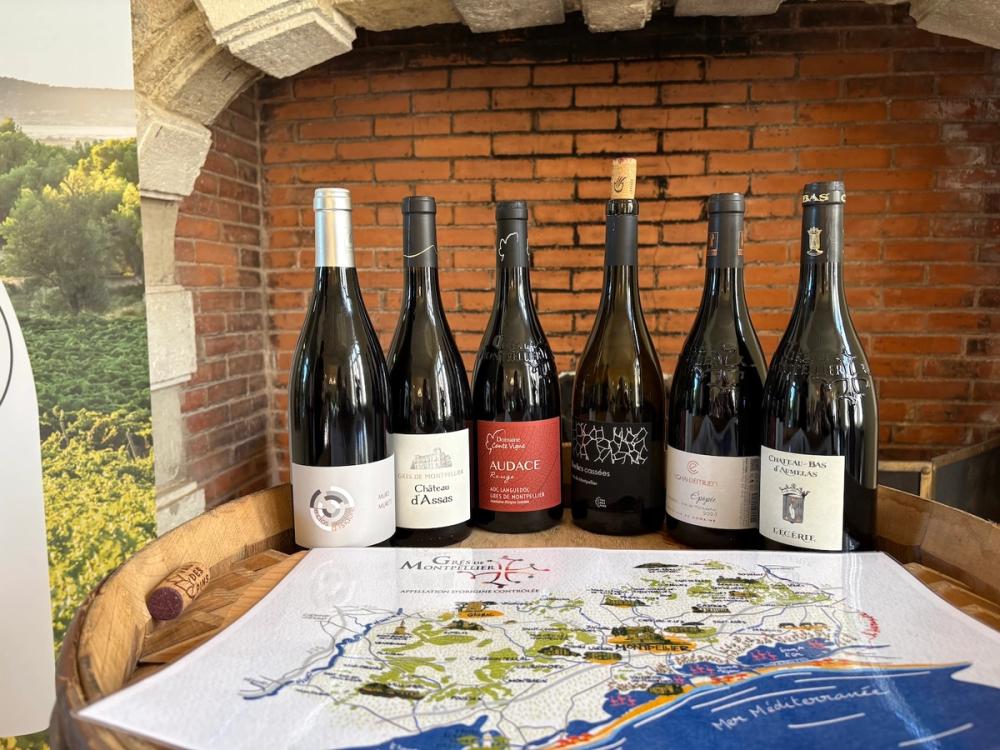
We enjoy a masterclass on the appellation at the beautiful old Château Saint Martin de la Garrigue where the chapel dates back to 987 AD. Wine made here has hallmark elegance and ageability, with fine tannins, an intense nose and a generous array of aromas. The château also proudly boasts terroir that can produce excellent Picpoul de Pinet, now so popular in Britain it has almost become a brand name in its own right.
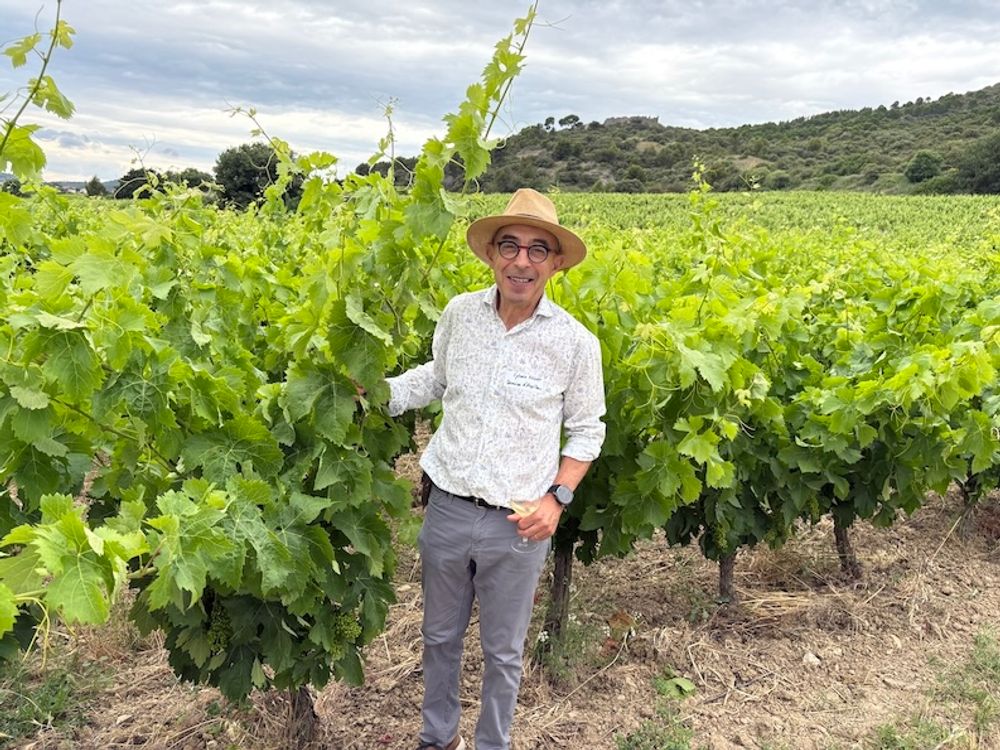
Sylvain Fadat founder of Domaine d’Aupilhac, President of Montpeyroux AOP in his Maset vineyards.
Montpeyroux AOP
The latest Languedoc appellation, announced this year, is AOC Montpeyroux. “It has taken 30 years for us to be recognised (from the 2026 vintage)”, says Sylvain Fadat founder of Domaine d’Aupilhac, President of Montpeyroux AOP. “It's not that long in the history of humankind except I now have a little less hair,” he chuckles.
Montpeyroux is around the historic village of the Languedoc bearing its name (the wine tasting is held in the village's beautiful chapel as well as in the vineyards). Montpeyroux is tiny – just 500 hectares – surrounded by AOP Terrasses du Larzac.
Montpeyroux's quality is as high as the AOP is in altitude (elevation up 350m) and that of its Terrasses du Larzac neighbours. The wines are sumptuous and full-bodied, deep purple in colour, with aromas of ripe fruit, spice and the garrigue. We witness the winemaker’s passion, wines and skills.
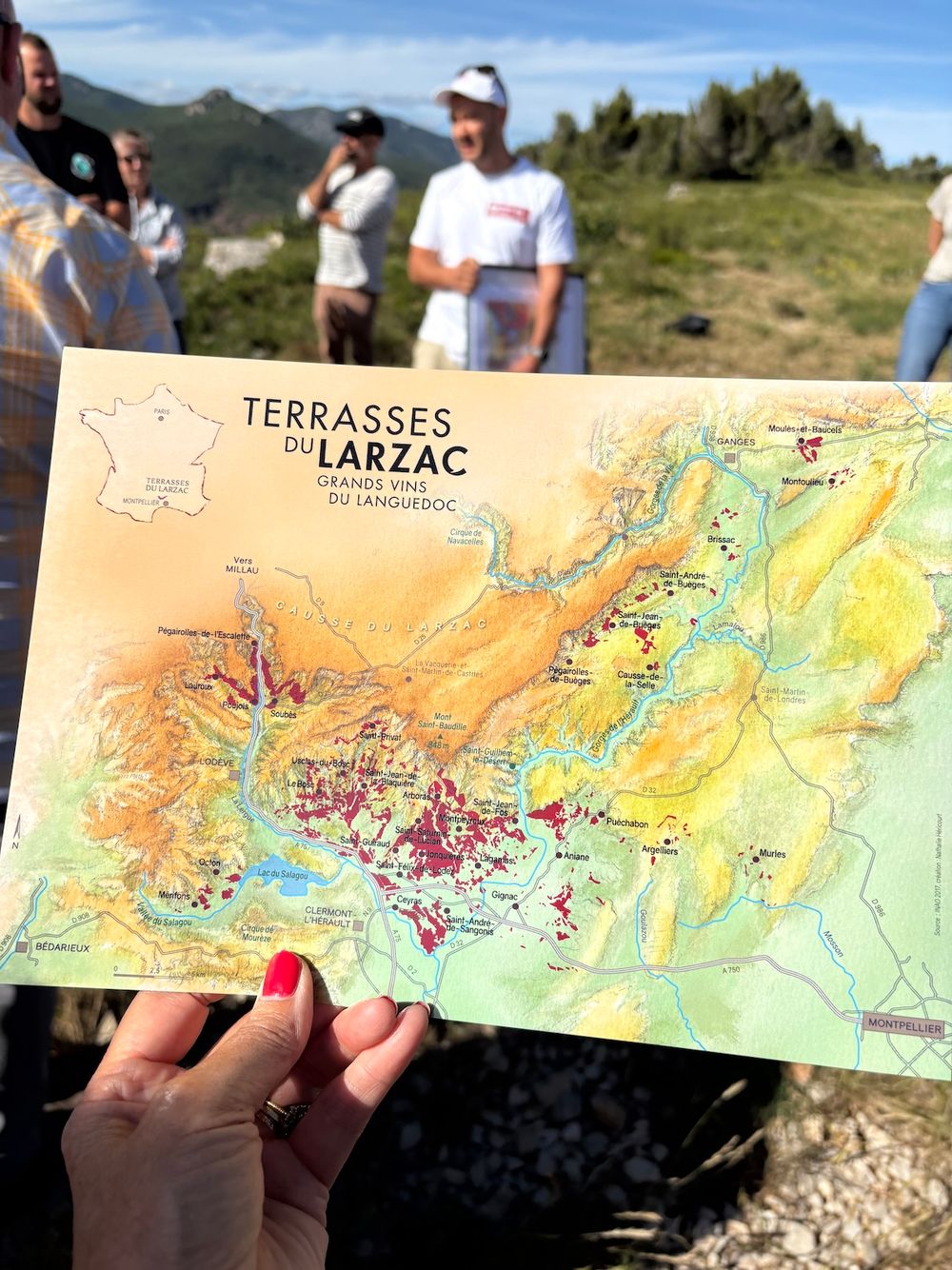
Terrasses du Larzac Blanc AOP upcoming?
While Montpeyroux is all about red wines, the exciting news from the stunningly located Terrasses du Larzac vineyards around the cool-climate Larzac plateau is that soon whites will be included too – AOC Terrasses du Larzac Blanc. It is the 10th anniversary of the appellation becoming an AOP. We met some of the oldest domaines in the region and some of the newest.
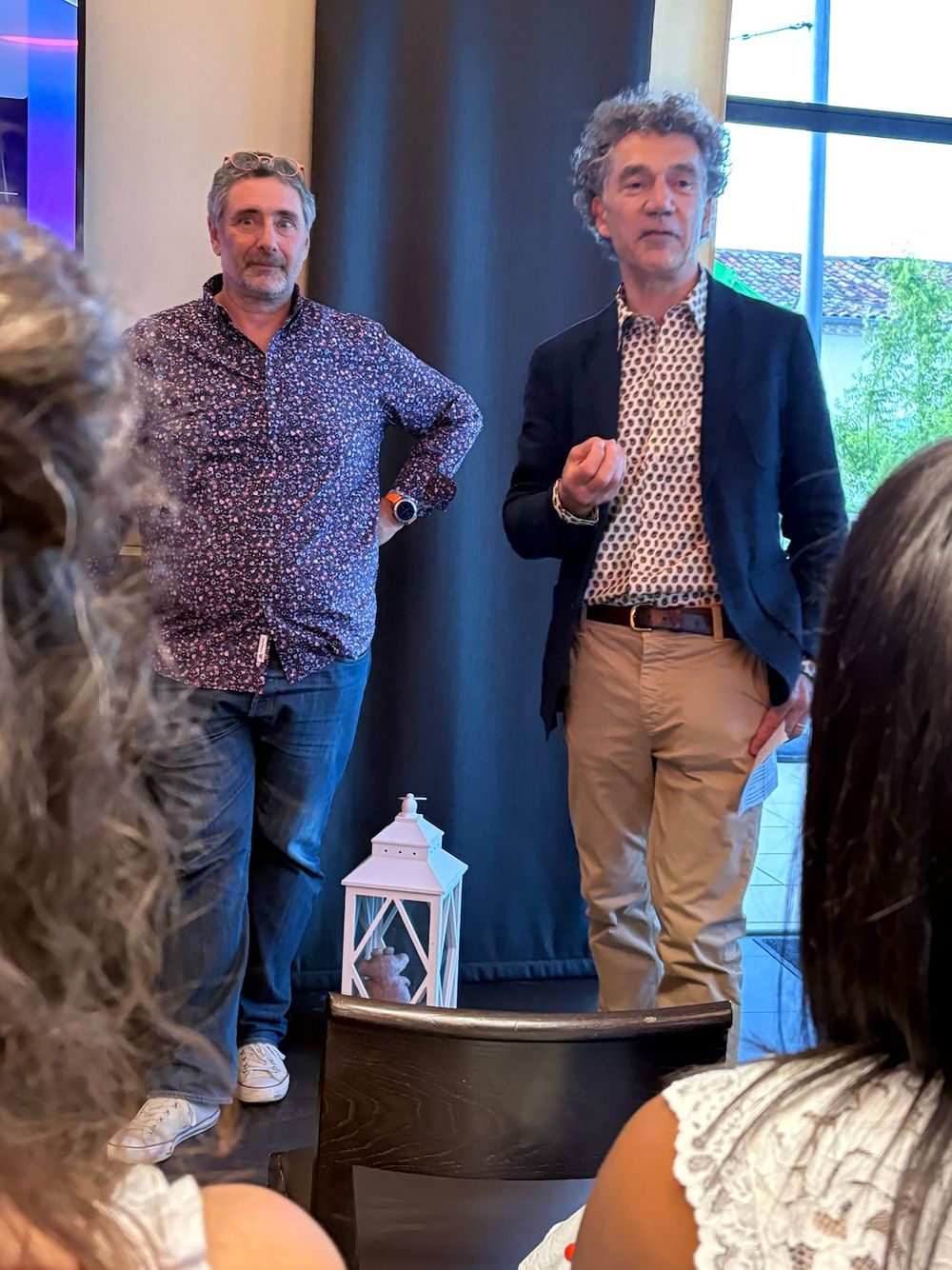
CIVL President, Pierre Borries (left) with Jean-Claude Mas of Les Domaines Paul Mas (right)
“Languedoc is the region for the new generation”
Will the Languedoc continue to increase the number of its AOPs, I ask the CIVL President, Pierre Bories. “Maybe there will become more sub-appellations a bit like Boutenac in Corbières,” he says. “The Languedoc is a complex region but that’s its beauty.”
He explains: “Every 20 kilometres there’s something new, the landscape and terroir changes, there’s so much to discover, to experience and enjoy. I take the analogy of the growth of TV channels. When I was little, there were only four channels, and now young people have hundreds at their fingertips and scroll on their phones constantly. I believe in a similar vein, it is the region for the new generation. Languedoc is dynamic: the young don’t want to drink the same wine as the parents. We want to show them the breadth of the wines and the beauty of the area for vacations. We continue to communicate subtle differences of terroir and vinification to wine experts, but we want people to stop thinking that they have to make an effort to understand wine.”
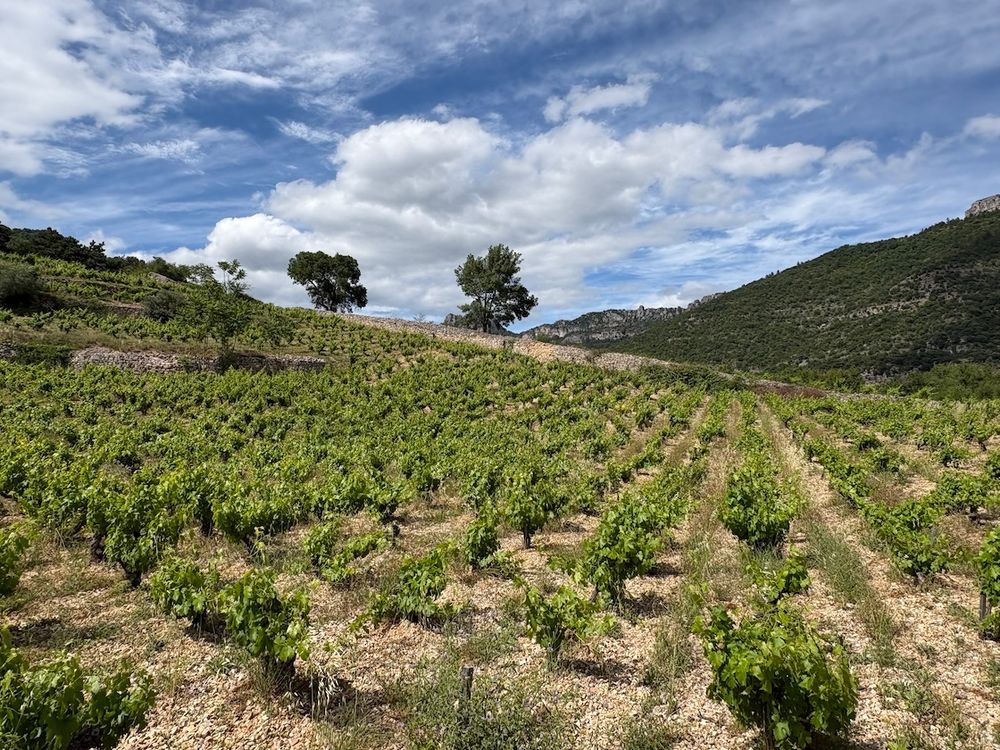
Cabrières vineyards
Cabrières AOP?
The next independent AOP hopeful is Cabrières, following in the footsteps of nearby sub-regions of Pic Saint-Loup and La Clape. Cabrières emphasises its high-altitude unique schist-based terroir. It is an area with an historic fine wine reputation, highly regarded for its fresh, yet structured, red blends and highly aromatic rosés. Gerard Bertrand’s Clos du Temple (€190 a 75cl bottle) is perhaps the best-known example. But there are excellent, more inexpensive, wines too. Domaine L’Estabel is the respected local cooperative and the Cinsault grape provides a crisp freshness.
Pézenas Languedoc is another hopeful. It is currently a sub-AOP denomination but is hoping to become a fully recognised cru.
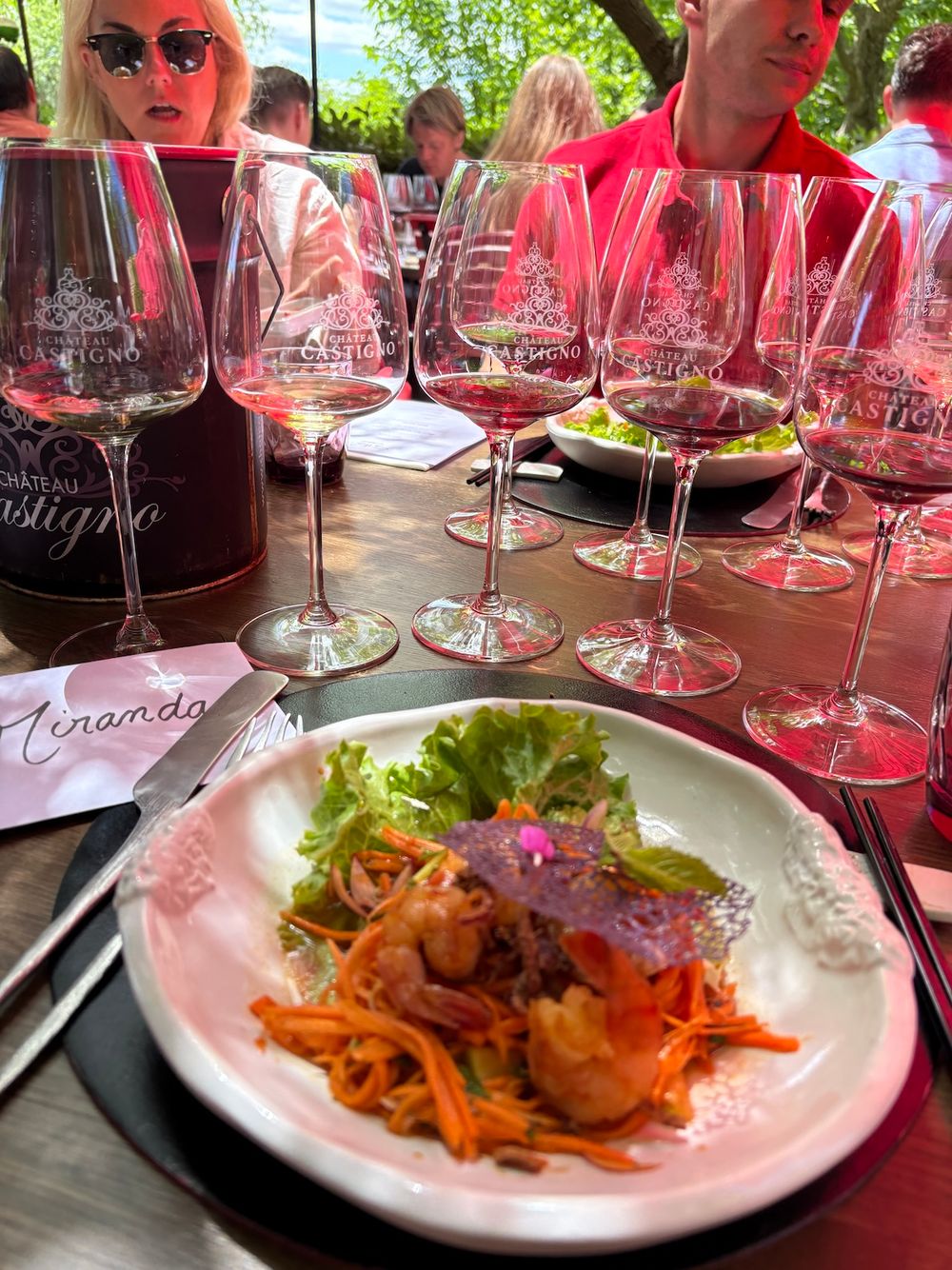
Pairing Saint-Chinian wines with Thai food
Tackling climate change
The Languedoc is not just dynamic, though, in the increasing number of AOPs recognised. Already boasting organic production by over a third of producers, we see throughout our tour how winemakers are responding with an urgency to the global impact of climate change, preserving and promoting biodiversity, experimenting with viticultural methods and going back to native varieties as well as exploring new disease-resistant PIWI clones.
In Saint-Chinian we enjoyed a presentation of what their wines might look like in ten years’ time, demonstrating how forward thinking the area already is. In Faugères we tasted wine from a new PIWI hybrid which has been identified to have promising qualities, the result of much hard work and local experimentation and discovered exceptional wines including from Domaine de Cébène and Domaine Binet Jacquet, the Grande Réserve de Schiste.
Yes, temperatures may soar in the summer and water is at a premium in the region, but it is evident how the Languedoc producers are responding fast to the global impact of climate change and how much any former bulk wine image can be cast aside.
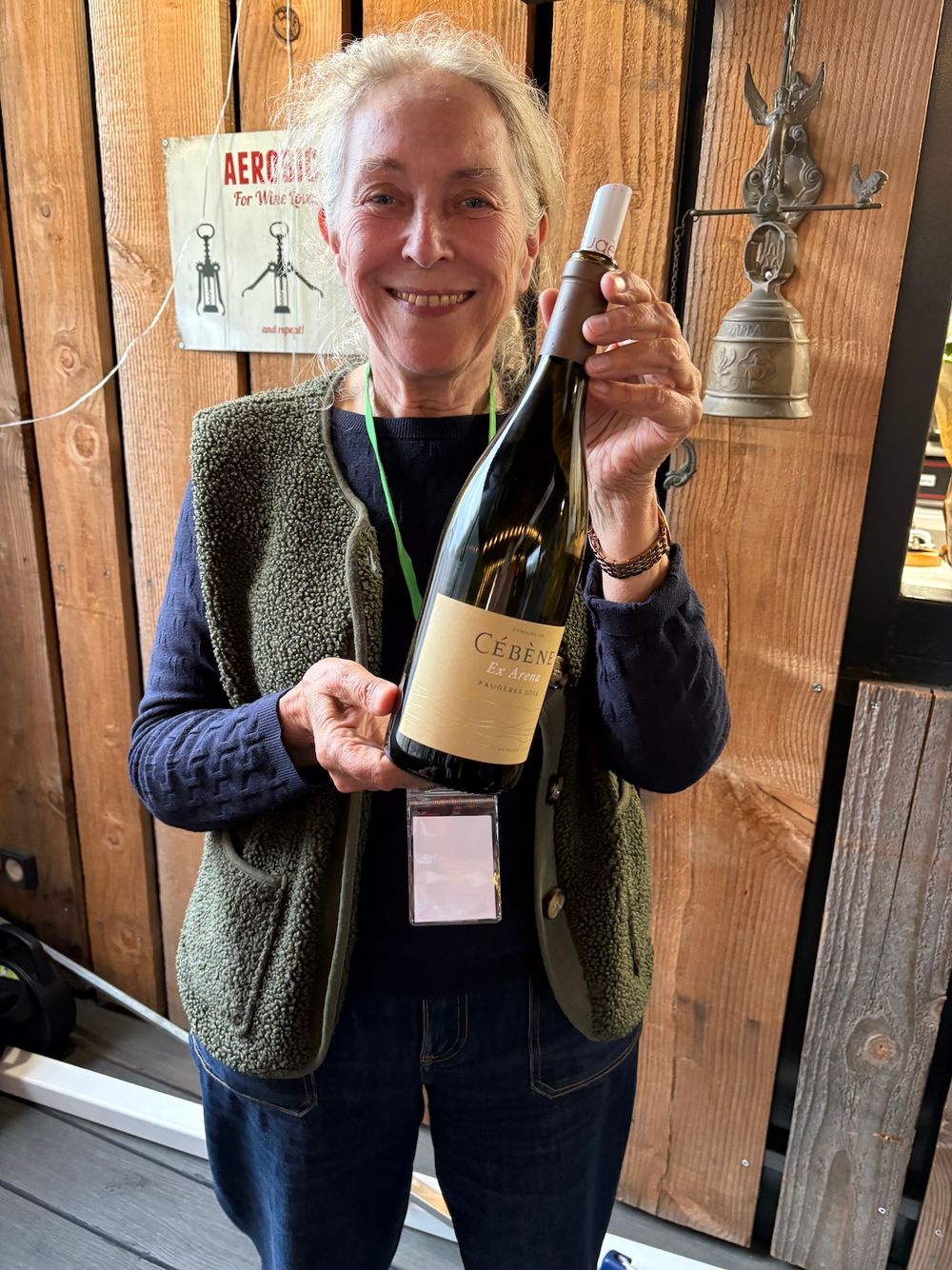
Brigitte Chevalier founder of Domaine de Cébène Faugères AOP
We met forward-thinking passionate winemakers with proud savoir-faire, producing top quality wines with a modern freshness. The region has a richness and patchwork of diverse styles and terroirs with great potential for discovery. The new appellations in the pipeline are the perfect example of what years of determined work to gain recognition can achieve.